Updated November 2026 · Free night-path planner

The 2 a.m. walk, minus the dark.

For adult children and older adults: light the path from bed to bathroom, stop by stop.

LitDark

Drag across: a lamp by the bed, two plug-in lights, a bathroom light left on.

Download on the App StoreTry it tonight · Free on iPhone

Map the night path, spot by spot

Pick the route your parent (or you) walks at night, then tap each spot that already has light after dark. Dark spots turn into a fix list, each line tied to the public guidance it comes from.

The route at night
    0 of 4spots lit at night

      Where should night lights go for an elderly parent?

      Put light at each point on the path they walk after dark: within reach of the bed, at the bedroom door, along the hall, at the top and bottom of any stairs, and in the bathroom. The National Institute on Aging's room-by-room fall prevention guide (reviewed September 2022) names each of those spots.

      The NIA says to "put night lights and light switches close to your bed," to "leave a light on in the bathroom at night or use a night light that turns on automatically in the dark," and to have switches at the top and bottom of stairs and at each end of a long hall. It also suggests motion-activated lights that plug into outlets, and a flashlight by the bed in case the power goes out.

      The reason it matters: the CDC's older adult falls facts (updated September 2026) say more than one out of four older people falls each year, and less than half tell their doctor.

      Light the whole route, not just the room: one dark doorway is where the walk goes wrong.

      Night lighting for seniors, compared

      Five kinds of light come up in the NIA and CDC guidance. They do different jobs, so most homes need two or three.

      Plug-in, dusk to dawnComes on by itself after dark. The CDC's home checklist mentions night-lights that "go on by themselves."Best at: bedroom door, bathroom. No wiring.
      Motion-activated plug-inTurns on as you pass. The NIA suggests these for stairwells and pathways.Best at: hallways, long routes.
      Lamp or touch lamp by the bedLight before standing up. The CDC checklist says to place a lamp close to the bed where it's easy to reach.Best at: the bedside.
      Glowing light switchEasy to find in the dark. The CDC checklist notes "you can get light switches that glow."Best at: bedroom and bathroom doors.
      Overhead stair light, switch at both endsThe CDC checklist says to have an electrician put in a light and a switch at the top and bottom of the stairs.Best at: stairs. A job for an electrician.

      Fire safety: the U.S. Consumer Product Safety Commission's nightlight warning says to place nightlights away from beds where the bulb might touch flammable materials, to look for the mark of a recognized testing laboratory, and to consider cooler mini neon bulbs over 4 or 7 watt bulbs.

      A visit home in November

      An illustration, not a real family.

      You stay over at your dad's. At 2 a.m. you get up for water and realize you can't see the edge of the hall rug. The switch is at the far end.

      In the morning you walk his route together: bed, door, hall, bathroom. Three of the four spots are dark. You buy two plug-in lights and a touch lamp before lunch. The hall switch goes on the list for an electrician.

      Before you leave, you note each fix on your phone so a month from now someone checks the lights still work.
      Night light questions

      Are motion-sensor or always-on night lights better for seniors?

      They do different jobs. The NIA suggests motion-activated plug-in lights for stairwells and pathways, and a bathroom light or a night light that turns on automatically in the dark. Many homes use always-on lights at the bedroom door and bathroom and motion lights along the hall.

      Should the bathroom light stay on all night?

      The NIA says to leave a light on in the bathroom at night or use a night light that turns on automatically in the dark. Either way, the goal is to never walk into a dark bathroom.

      Can a night light be a fire hazard?

      The CPSC warns that nightlights near beds can ignite bedding if the bulb touches it. Keep them away from bedding and curtains, choose ones with a testing laboratory mark, and consider cooler mini neon bulbs.

      Does this planner save anything?

      No. It runs in your browser and nothing is uploaded. Copy the fix list before you close the tab.

      How RoomMend keeps the fixes from slipping

      A fix list is easy to make and easy to forget. RoomMend is a free room-by-room home checklist and fix planner for your own home or a parent's, and "Too dark" is one of its common issues.

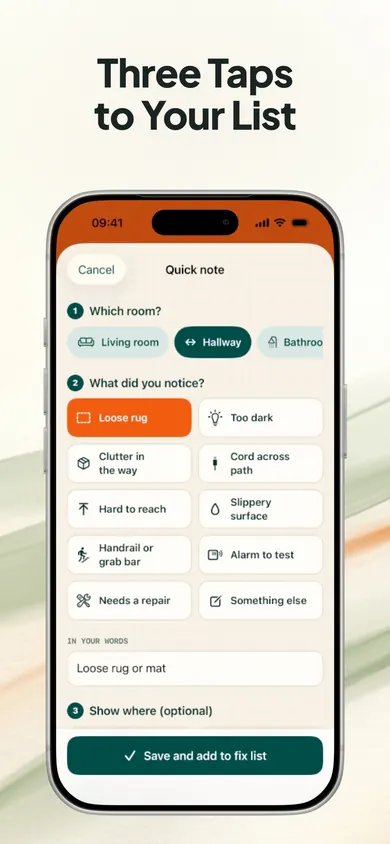
      1. RoomMend quick note with Hallway selected and issues such as Loose rug and Too dark
        Note it in three taps

        Choose the room, tap an issue like Too dark or Cord across path, and RoomMend suggests the fix. Pick This week, This month or Someday.

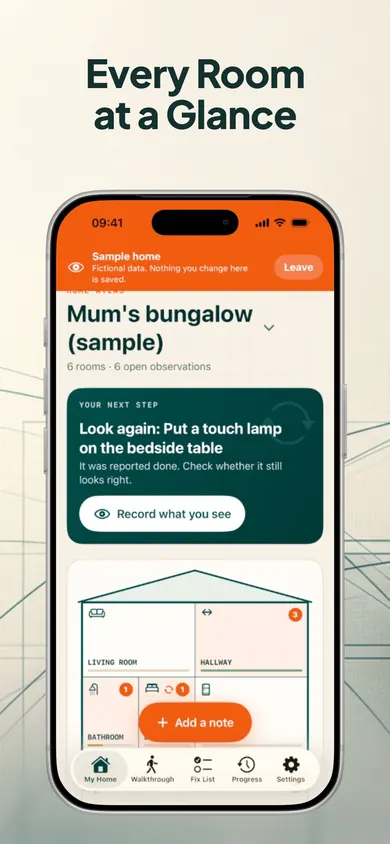
      2. RoomMend home screen with the next step: look again at a touch lamp on the bedside table
        One next step on the home screen

        Every time you open it, the home screen shows one thing to do: a fix that's due, a room to walk through, or something to look at again.

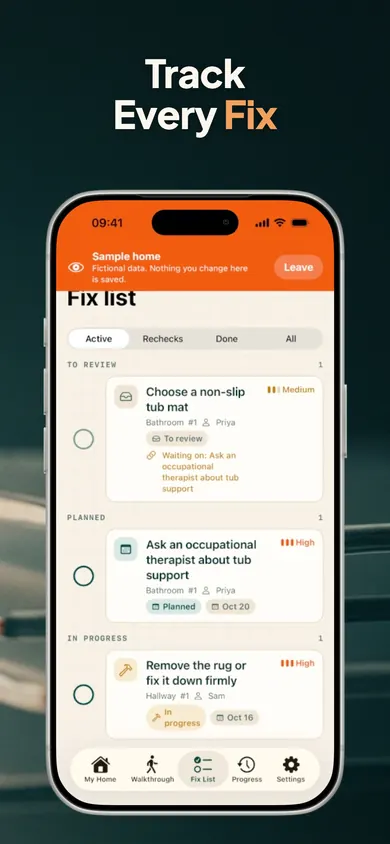
      3. RoomMend fix list with items to review, planned and in progress
        Tick it, then look again in 30 days

        Tick a fix when it's done and RoomMend plans a reminder to look again in 30 days, so a burnt-out bulb doesn't quietly undo the work.

      Honest limits

      We built the planner around the route, not the room, because that's how the NIA guidance reads when you put it in walking order. But it only knows what you tap: it can't see glare, a step, or a loose rug. RoomMend is the same. Its listing says it is not a home inspection or fall-risk assessment and does not detect hazards in photos. For electrical work, like a new stair switch, use a qualified electrician.

      Who should pick something else: if your parent has already fallen, feels unsteady, or gets dizzy at night, lighting is only part of it. Their clinician is the place to start.

      This is general information, not medical advice. Talk to your clinician.

      Light the path tonight. Check it again next month.

      Every walkthrough, unlimited rooms and notes, the fix list, reminders and rechecks are free in RoomMend.

      Download on the App StoreTry it tonight · Free on iPhone