What should a power outage plan for elderly parents include?
A good plan answers five things before the lights go out: what in the house needs power to keep your parent well, which medicines need cold, how they'll stay warm or cool, who checks on them and by when, and what never gets used indoors. Everything else is batteries and a printed phone list.
Ready.gov's power outage guidance starts in the same place: "Have alternate plans for refrigerating medicines or using power-dependent medical devices." Answer the chart below for your parent and the plan fills in as you go.
Does anything they use need power to keep them well?
Oxygen concentrator, CPAP, a powered bed or lift chair, a power wheelchair, a stair lift.
Do they keep any medicine in the fridge?
Insulin, some eye drops, some injections and liquid antibiotics.
Do they live alone?
Or alone most of the day, or with a partner who also needs help.
Do winter storms or heat waves hit where they live?
Outages and extreme temperatures often arrive together.
Might they use a generator, camp stove or grill?
Or might a well-meaning neighbor bring one round.
Your plan is ready.
Print it, tape it inside a kitchen cupboard, and send a copy to whoever lives closest.
Plan for the equipment and the medicines first; flashlights are the easy part.
Who should start somewhere else
If your parent depends on oxygen, a ventilator, dialysis at home or anything else they can't go a few hours without, this chart is a starting list, not a plan. Call the equipment supplier and their care team first: ask how long the battery lasts, what the backup is, and where to go if the power is out for a day. Ready.gov's older adults page also suggests asking regular treatment providers about their own emergency plans and back-up providers.
And if you need a full-household plan rather than one parent's outage sheet, Family Ready's free kit checklist and household plan go wider than this page.
What Family Ready keeps on the phone
Family Ready holds your parent's Emergency Card: who to call first, allergies, current medications and important health information. It's saved on the iPhone, so it opens without internet once the phone is unlocked, which is exactly the situation when the power and the Wi-Fi go together.
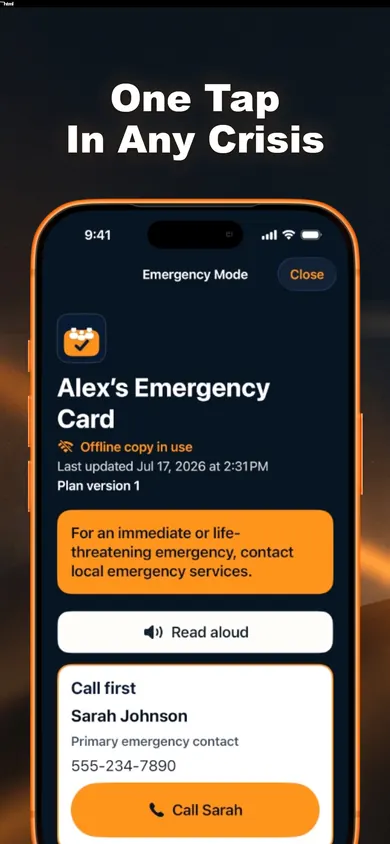
- 1"Offline copy in use": the card opens without signal or Wi-Fi once the phone is unlocked.
- 2Tap a contact to start the call yourself. Family Ready never calls or messages anyone automatically.
- 3High contrast, large text, no ads or purchase prompts in Emergency Mode.
- 4The free Emergency Snapshot PDF prints the same details, for the fridge door.
One design decision we'd defend: the Emergency Card never needs a subscription. The parts you'd reach for in the dark are free.
Honest limits
- No app helps if the phone is dead. Family Ready's own listing says to keep a printed copy, and this page's plan is built to print.
- Family Ready organizes information you enter. It is not an emergency-response, medical or monitoring service and does not contact emergency services.
- The decision chart here can't know your parent's medicines. The insulin figure below is FDA's general guidance; their pharmacist knows their exact products.
- This is general information, not medical advice. Talk to your parent's clinician or pharmacist about their medicines and equipment.
How to set it up in three steps
- Answer the chart for your parent. Print the plan and leave a copy where they'll see it, plus one with whoever lives closest.
- Make their Emergency Card in Family Ready. Who to call first, allergies, medications. Free, offline, and you can make one for a parent with their permission.
- Add the outage items to the kit checklist. The free checklist is based on Ready.gov and Get Prepared (Canada) guidance, with an optional section for older adults. Set a 6- or 12-month review reminder before storm season.
The numbers behind the plan
| Rule | Number | Source |
|---|---|---|
| Fridge keeps food safe, door shut | Up to 4 hours | FoodSafety.gov |
| Full freezer holds a safe temperature | About 48 hours (24 if half full) | FoodSafety.gov |
| Insulin in its original vial or pen, unrefrigerated at 59–86°F | Up to 28 days | FDA, September 2026 |
| Generator, grill or camp stove distance from doors, windows and vents | At least 20 feet, outdoors only | CDC |
Four hours for the fridge, 20 feet for the generator, and a printed plan for everything else.
Their card, even with no power.
The Emergency Card, Emergency Mode, kit checklist and Snapshot PDF are free in Family Ready.
This is general information, not medical advice. Talk to your clinician. In an emergency, call your local emergency number.