For anyone with no one else at home: flip three myths, then make a plan someone can find.
Start on your iPhone · Free on iPhone
From the Family Ready studio · Updated November 2026 · About 6 minutes to read
What should an emergency plan include if you live alone?
If you live alone, your plan has to work when you can't speak for yourself. It needs four things: medical details a stranger can reach from your locked phone, a person who knows your history, a way for someone to notice you've gone quiet, and a way for them to get in. Then put it on paper too.
You are far from the only one planning for this. In 2024, 29% of U.S. households, 38.5 million of them, were one person living alone, according to the U.S. Census Bureau's 2024 release. Most emergency plans are written for families. Below are seven facts, each with its source, that change the plan when the house is yours alone.
7 facts for an emergency plan for one person
Your locked phone can show your medical details, if you switch it on
Apple's support guide says that with "Show When Locked" turned on, first responders can open your Medical ID from the Lock Screen "without needing your passcode." A separate setting shares it automatically when you call or text emergency services (Apple Support, Medical ID).
Do this: Health app, Medical ID, Edit, then turn on both settings.
The right contact knows your medicines, not just your name
The American Academy of Pediatrics suggests choosing an emergency contact "who knows your medical history and can answer questions about allergies and medications" (HealthyChildren.org, AAP).
Do this: ask them first, then send them your current medicine list.
A check on you stops at a locked door
Marie Curie's guide to living alone says to tell your emergency contact how to get into your home, or give them a key (Marie Curie).
Do this: decide who holds a key, and write down where it is.
Someone has to notice you've gone quiet
Florida's Department of Health advises sharing your plans with "trusted friends, neighbors, or family who can check on you" and enrolling in check-in programs (Florida Health).
Do this: agree a daily check-in time and what happens if you miss it. The card generator below writes it out.
Paper beats a phone with a flat battery
Marie Curie suggests keeping contact and care-team details "somewhere noticeable, for example on the fridge." We say the same in our own app listing: no app can help if a phone is lost or out of battery.
Do this: print one page and stick it on the fridge or inside the front door.
Medicines run out faster than you think
Ready.gov warns that an emergency can make it hard to refill a prescription or find an open pharmacy, and recommends a kit with water, at the rate of one gallon per person per day for several days, plus copies of insurance and ID (Ready.gov, Build a Kit).
Do this: note your refill dates and keep a short spare supply where your pharmacist says that's possible.
Pets need a plan when you can't get home
Marie Curie also suggests listing tasks someone would need to cover while you're away, such as caring for a pet. With no one else at home, that list is the only way a helper knows the dog hasn't been fed.
Do this: write feeding times, the vet's number and where the lead is.
Plan for the moment you can't explain anything yourself.
A short what-if
Imagine a slip on the bathroom floor on a Tuesday evening. The phone is in the kitchen. Your sister texts at 8pm like always, and nothing comes back.
Without a plan, she waits and wonders. With one, she knows: try twice, call at 9, then the neighbor two doors down uses the spare key. If paramedics come, the Lock Screen and the fridge both say what you take, what you're allergic to and who to call.
This is a made-up scene, not a real case. It shows why a check-in plan names times and people, not just good intentions.
Make your "If I go quiet" check-in card
Fill in the blanks and print the card for your check-in person and your fridge. Nothing you type leaves this page.
One design decision: the card ends with "call the emergency number" only when someone has actually seen a problem. A missed text is a reason to check, not a reason to panic.
Where Family Ready fits
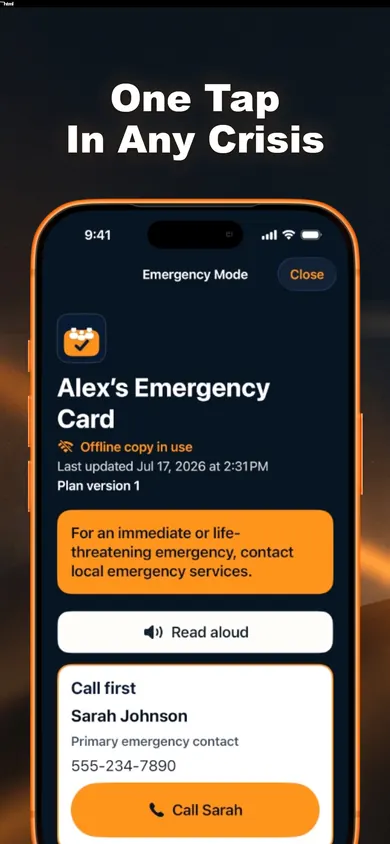
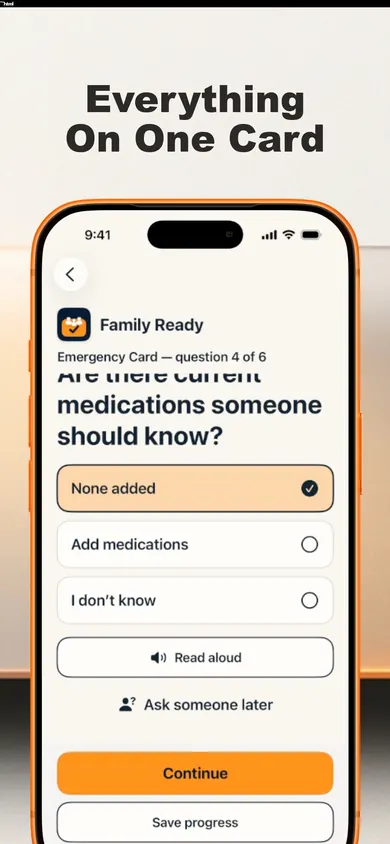
Family Ready builds the medical half of this. The free Emergency Card holds who to call first, allergies, current medications and important health information, saved on your iPhone so it opens in Emergency Mode without internet once your phone is unlocked. Emergency Mode is a large-text screen where you tap a contact to start a call yourself. The household plan has sections for dependants and pets, and the free Emergency Snapshot PDF is the page for your fridge.
Emergency Mode, offlineOne question at a time
Pick a 3, 6 or 12 month review reminder so the card doesn't go stale. With Family Ready Plus, an optional subscription, you can invite a trusted person to view only the sections you allow.
Who should pick something else
You need help called for you. Family Ready is not a monitoring or emergency-response service. It never calls or messages anyone automatically. If falls are your worry, look at a personal alarm service or a watch with fall detection.
You need automatic check-ins. The card above is a plan between people. Family Ready does not send check-in texts.
You're on Android. Family Ready is iPhone only. The printable card works anywhere.
Honest limit: Family Ready only knows what you type in. If a medicine changes and you don't update it, the card is wrong.
Living alone emergency plan FAQ
Who should be my emergency contact if I live alone?
Pick someone who knows your medical history and can answer questions about your allergies and medicines, as the American Academy of Pediatrics suggests. Ask them first, and consider a second person who lives close enough to come over.
Should I give a neighbor a spare key?
If you trust one, it helps. Marie Curie's living-alone guide suggests telling your emergency contact how to get into your home or giving them a key, so a check on you does not stop at a locked door.
How often should I update my emergency plan?
Whenever a medicine, doctor or contact changes, and on a set schedule in between. Family Ready lets you pick a 3, 6 or 12 month review reminder.
Is an emergency plan app enough on its own?
No. A phone can be lost, locked or flat. Keep a printed copy on the fridge or by the door, and make sure at least one person knows where it is.
This is general information, not medical advice. Talk to your clinician about medicines and health conditions. In an emergency, call your local emergency number.
Your card, on your phone and the fridge.
The Emergency Card, Emergency Mode and the Snapshot PDF are free.