
The plan in brief
How to help your child catch up in math at home
Find the first skill that wobbles, go back to it, and practise for about 10 minutes a day with objects, drawings and a number line. Bring yesterday's problems back tomorrow and again a few days later. One calm week of that tells you more than a weekend of worksheets.
That advice comes from two U.S. Department of Education practice guides from the What Works Clearinghouse. The 2021 guide on helping students who struggle with math rates all six of its recommendations as having strong evidence, including systematic instruction, concrete and drawn representations, number lines and word problems. The guide on organizing study adds spacing reviews over time and short quizzes that make kids pull an answer from memory.
- 1
Find the first wobble
Work backwards from today's homework until your child gets five in a row right without counting on fingers. The skill just above that is your starting point.
- 2
Make it visible
Use coins, pasta, a drawing or a number line on the fridge. Then say what you did in math words: "ten ones make a ten".
- 3
Bring it back
Ask two of yesterday's questions before anything new, and again three days later. Remembering is the practice.
Catching up starts one step behind where the class is.
Your options this week
Catch-up math options, side by side
A tutor
A person who can see where your child is stuck and adjust on the spot. The best fit for a large gap, if it fits your budget.
Workbooks
Cheap and screen-free. You choose the pages, so you need to know where the gap is and remember to circle back.
Brainy Bucks
Ours. A daily 5, 10 or 15 minute quest that mixes new skills, review and earlier mistakes, and checks skills again days later.
Make your plan
Your first-week math catch-up plan
Choose the skill your child is stuck on and how long you have. The plan follows the guides above: a gap check, hands-on work, a number line, mixed review, a word problem and a recall check, with one day off. Print it for the fridge.
One design decision: the plan never adds a timed drill before day 5. The 2021 guide does recommend timed activities as one way to build fluency, but a timer on a skill that isn't secure yet mostly measures nerves.
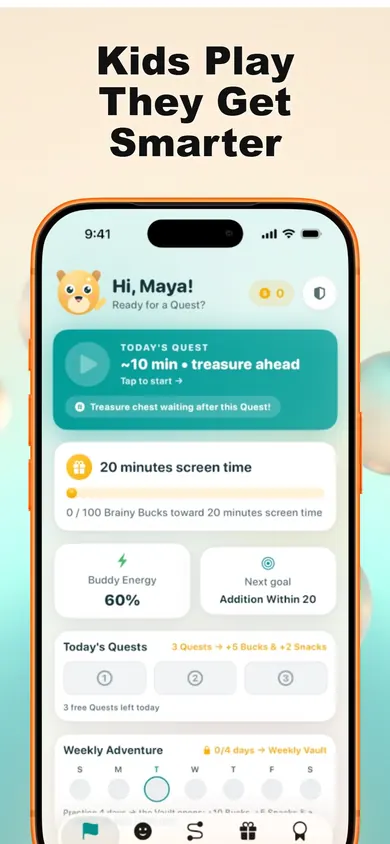

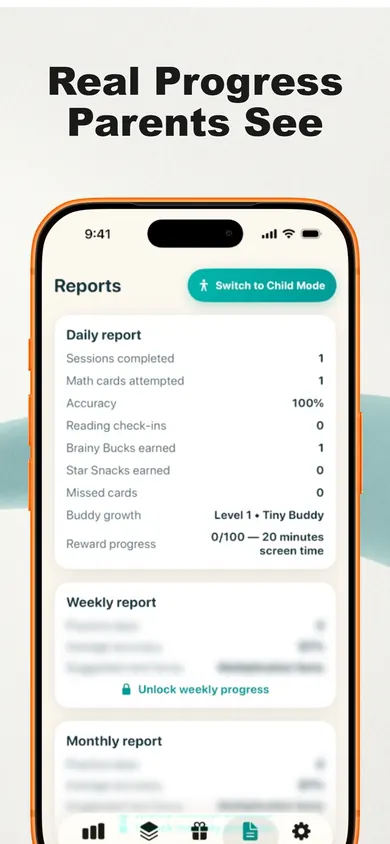
If you'd rather the review schedule ran itself, that's the job Brainy Bucks does. Missed questions come back in later quests, a wrong answer gets a clue and a second try instead of a red X, and each week you get a one-sentence summary and up to three short suggestions for what to practise next. One adaptive quest is free every day, with no ads and no accounts. You can try a 5-question sample quest in your browser first.
Fair warning
Who should pick something else
- Your child is more than a grade behind. Talk to the teacher and consider a tutor. An app is a practice tool, not a diagnosis.
- You want everything screen-free. Use the printed plan above on its own. It works without any app.
- Your child is in middle school. Brainy Bucks covers Pre-K to Grade 8, but its deepest coverage is Kindergarten to Grade 4.
- You're on Android. Brainy Bucks is iPhone only.
Honest limits
What one week can and can't do
A week shows you where the gap is and whether short daily practice helps. It won't close a big gap. The skill statuses in Brainy Bucks, from Introduced to Retained, are based only on answers given in the app and are not a formal assessment. For context, the 2024 Nation's Report Card found 39% of U.S. fourth graders at or above NAEP Proficient in math. A child who is behind has a lot of company.
Ten calm minutes a day beats one long fight a week.
Parent FAQ
Catching up in math: common questions
How long does it take for a child to catch up in math?
It depends on how big the gap is. One missing skill, like adding within 20, can firm up in a few weeks of short daily practice. A gap that spans a whole grade takes months, and is worth raising with the teacher.
Should I go back to easier math or stay at grade level?
Go back to the first skill that wobbles, then climb. The Department of Education's intervention guide favours systematic instruction that builds each idea on the one before it.
Are timed math drills bad for kids?
Not in small doses. The Department of Education's 2021 guide recommends regularly including timed activities as one way to build fluency. Keep them short, against the child's own last score, and after accuracy is solid.
When should I talk to the teacher?
Now, if you can. Ask which skills they see slipping and what the class is doing next. If the gap keeps growing after a few weeks of steady practice, ask the school about an evaluation.
Let the review schedule run itself.
A short daily quest that brings back yesterday's mistakes, and a weekly plan for you. One quest is free every day.