Updated November 2026 · For parents

Stop drilling. Start building.

For parents teaching times tables at home: move the line, split a hard fact into two easy ones.

7 × 8
0 of 4

Move the line to a fact you know, then pick the answer.

Download on the App StoreOpen Brainy Bucks in the App Store · Free on iPhone

The short answer

How do you teach times tables at home?

Teach a few strategies first (doubles, fives, tens, and splitting a hard fact into two easier ones), practice only facts your child can already work out, keep timed rounds to 1 to 5 minutes, score correct answers rather than speed, and track progress privately against their own last score. Five minutes most days beats an hour on Sunday.

That's the shape of Recommendation 6 in the U.S. Department of Education's What Works Clearinghouse practice guide on math intervention (March 2021), written for teachers of children who find math hard. It rates the evidence for brief timed activities as strong, and then spends pages warning against the way most of us were drilled.

Speed comes from strategies a child trusts, not from a stopwatch.

Five mistakes

Times tables mistakes parents make, and the fix

None of these are character flaws. Most are how we learned. Here's what the guide's panel says instead.

Mistake 1Starting with the timed sheet

A page of 50 facts and a kitchen timer on day one.

Fix

The full guide (PDF) is direct: "Do not use timed activities to introduce and teach mathematics concepts and operations." Teach the strategy first, over many short sessions, and add the clock only once your child can get the answer without it.

Mistake 2Marching from 1s to 12s

Reciting each table in order, so 7 × 8 only works if you sing your way up from 7 × 1.

Fix

Teach facts in families that lean on each other. Once a child knows 5 × 8 and 2 × 8, then 7 × 8 is just 40 + 16. That's the move in the game at the top, and it's why arrays (rows of dots) help: you can see the split.

Turnarounds halve the job, too. A 10 × 10 table has 100 facts, but if 3 × 4 and 4 × 3 count as one, there are only 55 different facts to learn.

Mistake 3Racing a sibling, or the class chart

Public scoreboards and "who's fastest" games.

Fix

The guide suggests "meet or beat" goals against a child's own previous score, or a shared team score, and says that if you track progress individually, "make sure the graphs are kept private."

Mistake 4Counting how many they tried

Praising 40 attempts when 15 were guesses.

Fix

"Accuracy is the goal; not how many problems were attempted," the panel writes. If a child races and guesses, show them the score is correct answers only, and invite them to slow down next round.

Mistake 5The long weekend session

Forty-five minutes on Sunday, nothing all week.

Fix

The guide's timed activities last 1 to 5 minutes and are one small part of a lesson, not the lesson. Short and frequent also leaves room to bring back yesterday's misses, which is how facts stick.

Teach the trick, practice what they can already work out, and let the clock come last.

Where to start

What order should you teach times tables?

We'd start with the facts that make other facts easy. This order is ours, built on the split-a-fact idea above, not an official sequence:

By the time you reach the 7s, almost every fact is a turnaround of one your child already knows. Only 7 × 7 is genuinely new.

Honest bit

Who this approach is not for

If your child still counts on fingers for small additions like 6 + 7, multiplication strategies will feel like a wall. Spend a few weeks on addition first. And if math has been a struggle for a long time, or every session ends in tears, talk to their teacher about whether a closer look is needed. A home routine is not an assessment.

Brainy Bucks may not be the right pick either if you want a multiplication-only drill app: it mixes math with reading and phonics, and it spans Pre-K to Grade 8 with the deepest coverage from Kindergarten to Grade 4.

How Brainy Bucks fits

A 5-minute practice routine, in 3 steps

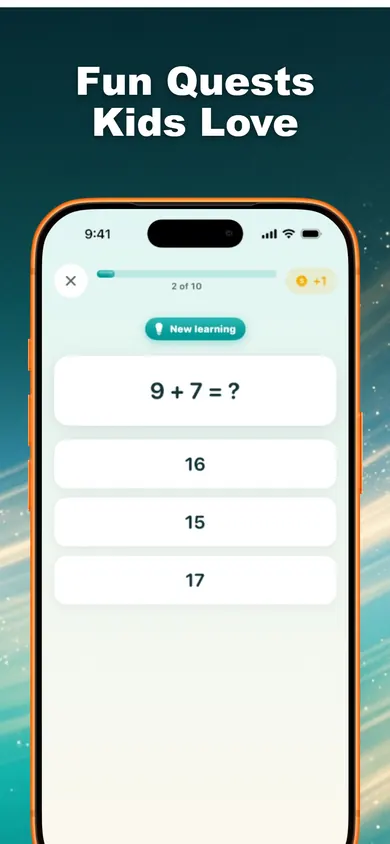
Brainy Bucks quest question showing an addition card with three answer choices
  1. Pick 5 minutesToday's Quest comes in 5, 10 or 15 minute sizes and mixes new skills, review and earlier mistakes.
  2. Let mistakes come backNo red X. A wrong answer gets a clue and a second try, and missed questions return in later quests.
  3. Read the weekly lineYou get a one-sentence summary and up to three short suggestions, built from your child's real answers.

One design decision we'd defend: there are no lives to lose. Brainy Bucks does include 90-second Brain Sprints for kids who like a race, but the daily quest itself has no time limit. Rewards are earned by practicing, and nothing is sold to children: Child Mode shows no prices, and purchases sit behind a parent PIN.

A week, roughly

How the switch can go

An illustration, not a real family.

Monday. The 7s worksheet comes home. Your nine-year-old knows 7 × 2 and 7 × 5 cold, and freezes on 7 × 8.

Tuesday. No sheet. You draw 7 rows of 8 dots and a line under row 5. "What's above the line?" Forty. "Below?" Sixteen. A pause, then "fifty-six."

Thursday. Five minutes of mixed facts, scored as correct answers only. Eleven. Friday: twelve. Nobody else sees the number.

Next Monday. 7 × 8 comes back in the mix and gets answered without the dots.

From the game

What your child's game result means

Play the game at the top first

Finish the four facts and this box turns your round into a next step.

This is a 20-second demo, not a test. It can't tell you what your child knows, only which split they reached for.

Your options

Flashcards, printables or an app?

All three can work. Brainy Bucks is ours, so weigh our view accordingly.

OptionGood atWeak at
Paper flashcardsCheap, screen-free, you see every answerYou must track misses and bring them back yourself
Printable worksheetsEasy to hand out; fine once strategies are solidA full page can feel like a wall; the guide warns sheets alone don't build fluency
Brainy BucksAdapts to answers, brings misses back, read-aloud, weekly plan for youIt's a screen; statuses come only from in-app answers, not a formal assessment

Five minutes a day, no red X.

One adaptive quest is free every day, with hints, second tries and a weekly learning plan for you. No ads, no accounts.

Download on the App StoreOpen Brainy Bucks in the App Store · Free on iPhone