Updated November 2026 · Free printable

4 meeting places. One card in every pocket.

For families apart all day: fill in your spots, print a wallet card for each person.

0/4
Meet here firstTap a pick or type one
Download on the App StoreMake it a habit with Family Ready · Free on iPhone

What is a family emergency meeting place?

A family emergency meeting place is a spot everyone agrees on in advance, so you can find each other when you can't stay home or can't get there. FEMA's Family Emergency Communication Plan form (2019) asks for four of them, from a room inside the house to a relative's home out of town, because different emergencies push you different distances.

The American Red Cross version is shorter: its family plan guidance asks for two places, one "right outside your home in case of a sudden emergency, such as a fire," and one "outside your neighborhood, in case you cannot return home or are asked to evacuate." The four levels below include both.

  1. 1
    IndoorFor a tornado or high-wind storm, when you stay put. FEMA's example: an interior room with no windows. Example: the downstairs bathroom.
  2. 2
    In your neighborhoodFor a sudden emergency like a house fire. Close enough to walk out to, far enough from the house. Example: the mailbox at the end of the drive.
  3. 3
    Outside your neighborhoodFor when you're out and can't get home: a road is closed, or the block is evacuated. Example: the public library on Main Street.
  4. 4
    Outside your townFor a wider evacuation. Usually a relative's or friend's home. Example: Aunt Rosa's house, two hours north.

One meeting place covers a house fire; four cover the day your family is in four different places when it happens.


Build your meeting place card

Fill in what you have; blanks print as a line to write on. Add up to six names and you get one wallet card each, sized like a bank card (3.375 × 2.125 inches) with dashed cut lines when printed. Nothing you type leaves this page, and it's gone when you close the tab.

Somewhere open and familiar to every age.
Who gets a card
0 of 4 places filled

The cards carry FEMA's tip on the bottom line: a text may get through when a call won't.


How to choose a meeting place your kids will find

  1. Pick places everyone already knowsReady.gov's plan for kids asks for meeting places that are "safe, familiar, accessible" and "easy to find." A spot a nine-year-old can name without thinking beats a better spot they've never been to.
  2. Name one out-of-town contactReady.gov says to "pick the same person for each family member to contact" and to choose someone out of town, since they may be easier to reach. FEMA's form adds that a text message may get through when a phone call will not.
  3. Walk it, then write it downWalk to spots 2 and 3 once with the kids. The Red Cross says everyone should have emergency contact information "in writing or saved on their cell phones." FEMA's form says to review and practice the plan at least once a year.

Here's how the four places compare at a glance.

PlaceUsed forWho decides
IndoorTornado, high windThe adults, by room
NeighborhoodHouse fire, gas smellEveryone, together
Outside neighborhoodCan't get homeAgree with teens too
Out of townEvacuationCheck with the host

The best meeting place is the one your youngest can find without you.


Keep the rest of the plan with Family Ready

A wallet card holds four places and a phone number. Family Ready holds everything around it. It's free to download, and the Emergency Card never needs a subscription.

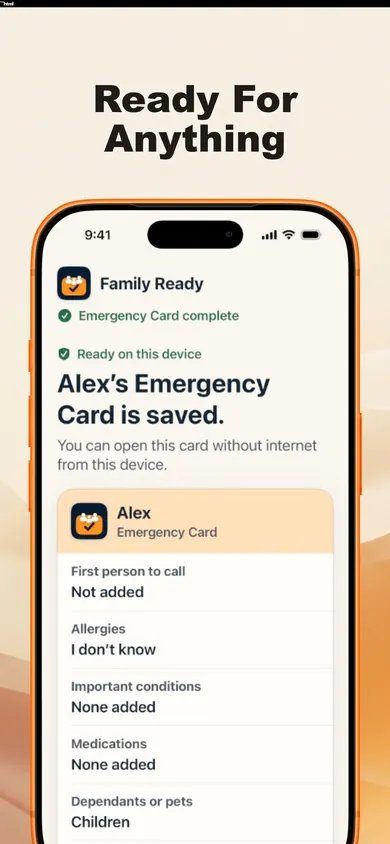
Family Ready showing an Emergency Card saved and ready on the device1

1. An Emergency Card for each person. Who to call first, allergies, current medications and important health information, saved on your iPhone so it opens without internet once the phone is unlocked.

Make one for yourself, your child, a parent, a partner, or someone you care for with their permission.

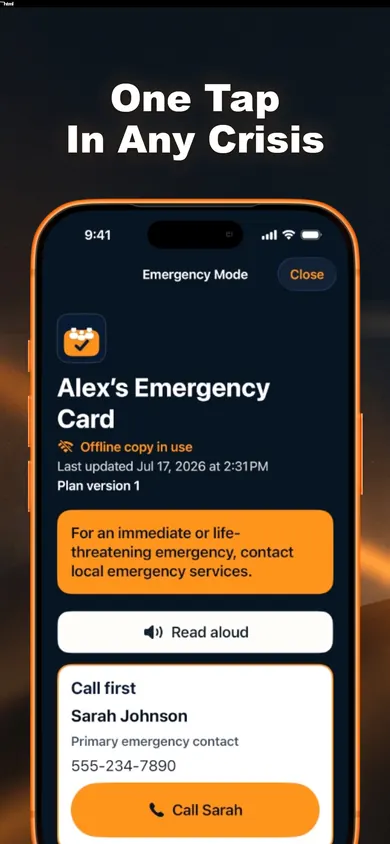
Family Ready Emergency Mode with large text and a Call first contact2

2. Emergency Mode. One tap opens a high-contrast, large-text screen with no ads and no purchase prompts. Tap a contact to start a call yourself.

Family Ready never calls or messages anyone automatically.

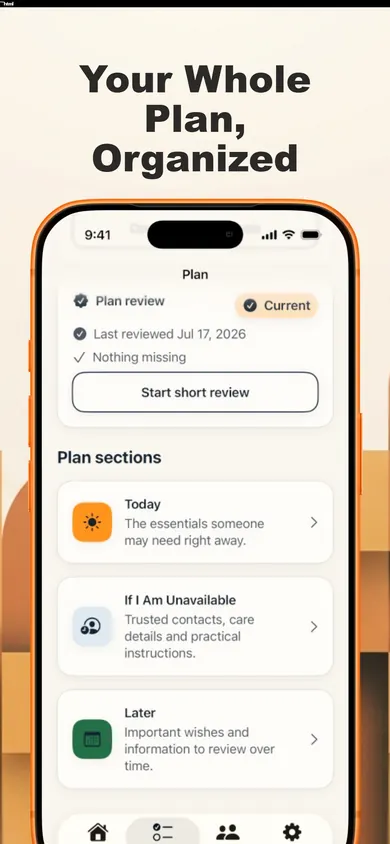
Family Ready plan screen with plan review and plan sections3

3. A household plan, at your own pace. Sections for contacts, health, important documents, money and insurance, home, dependants and pets, and more. Skip what doesn't apply.

Choose a 3, 6 or 12-month review schedule, and print a dated Emergency Snapshot PDF for free.


A Tuesday, 2:40 p.m.

An illustration, not a real family.

A water main breaks two streets over and police close the road home. Dad is at work across town. Sam, 14, is walking back from school. His phone is at 6%.

The calls don't connect. Sam doesn't need them to: the card in his phone case says place 3 is the library on Main Street. He texts the out-of-town contact, Aunt Rosa, "at library," and his phone dies.

Dad texts Rosa too. She replies to both. By 3:30 they're at the same table in the library.


Meeting place questions

How many family meeting places do you need?

At least two: one right outside your home and one outside your neighborhood, as the Red Cross recommends. FEMA's family communication plan form adds an indoor spot for storms and one outside your town for evacuations.

What makes a good meeting place for kids?

Somewhere they already know, can reach on foot, and can name without help. A landmark like a mailbox, a neighbor's porch or the school library works better than an address they've never visited.

Why pick an out-of-town contact?

When local calls fail, a long-distance contact may be easier to reach, and one person can pass messages between everyone. FEMA notes that a text may get through when a phone call will not.

Is anything I type on this page saved?

No. The cards are built in your browser and nothing is uploaded. Print before you close the tab.

Does Family Ready track where my family is?

No. Its listing describes no maps or location sharing, and it never calls or messages anyone automatically. It organizes the information you enter.


Honest limits

We made these cards paper on purpose: Family Ready's own App Store listing says no app can help if a phone is lost or out of battery, and the card still works then. The trade-off is that paper goes stale, so set a review date. Family Ready organizes information you enter. It is not an emergency-response service and does not contact emergency services; in an emergency, call your local emergency number. Who should pick something else: if what you want is to see where everyone is right now, your phone's built-in location sharing does that, and Family Ready doesn't.

Four places on paper. The whole plan on your iPhone.

Emergency Card, Emergency Mode, the household plan, a kit checklist and the Emergency Snapshot PDF are free.

Download on the App StoreMake it a habit with Family Ready · Free on iPhone