The after-reading question picker
That was an inference question: the answer isn't written down, so your child has to put the clues together. Inference is one of six comprehension strategies in the U.S. Department of Education's reading guide (more below). Pick a strategy and a moment, and you'll get a question that works with any chapter book or picture book.
What do you think happens on the next page? What makes you think that?
Ask for the reason as well as the guess. The reason is where the thinking shows.
What does reading comprehension look like in 3rd grade?
By third grade, comprehension means more than retelling: a child should explain why things happen, use clues to work out what the text doesn't say, and notice when they've lost the thread and go back. The Institute of Education Sciences' practice guide Improving Reading Comprehension in Kindergarten Through 3rd Grade (2010) gives five recommendations. The first, rated strong evidence, is to teach children how to use comprehension strategies.
The guide names six: activating prior knowledge and predicting, questioning, visualizing, monitoring and fix-up, drawing inferences, and summarizing or retelling. It was written for teachers, so treat what follows as a parent's version, not the guide itself.
Teach the strategies
Name the move out loud ("I'm going to picture this part"), show it, then let your child try. The six strategies are the picker above.
Notice how the text is built
Stories have a problem and a fix. Fact books have causes, steps and comparisons. Ask: "What was the problem? How did it get solved?"
Talk about the meaning
Open questions with no single answer, like "Was that fair?", where your child does most of the talking.
Choose books on purpose
Pick texts that fit the strategy: a mystery for inferring, a how-to book for sequence, a vivid story for picturing.
Make it something they want to do
Let them choose some books, and connect reading to things they care about.
One good "how do you know?" teaches more than five "what color was the dog?"
Why third grade reading comprehension gets attention
The 2024 NAEP reading results, the Nation's Report Card, say 40 percent of fourth graders scored below NAEP Basic, and 31 percent scored at or above Proficient. NAEP tests fourth grade, not third, but the year before is when a lot of the groundwork is laid. Those numbers describe the country, not your child. They're a reason to keep up a small habit at home.
| Instead of | Try |
|---|---|
| "Did you like it?" | "Which part would you change, and why?" |
| "What color was the dog?" | "How did the dog feel? What clue told you?" |
| "Read it again." | "Which word lost you? Let's go back to it." |
| "Tell me everything." | "Tell me the story in three sentences." |
A 10-minute reading routine that sticks
- Read for 5 to 7 minutesYour child reads aloud, or you take turns by page. Stop once in the middle and ask a "during" question from the picker.
- Ask one question afterJust one, from a different strategy each night. If the answer is a guess, ask "what clue told you?"
- Treat wrong answers as cluesPoint back to the sentence that helps and let them try again. Brainy Bucks works the same way: a wrong answer gets a clue and a second try, never a red X.
Same book, a different question each night: that's how one strategy turns into six.
Where Brainy Bucks fits
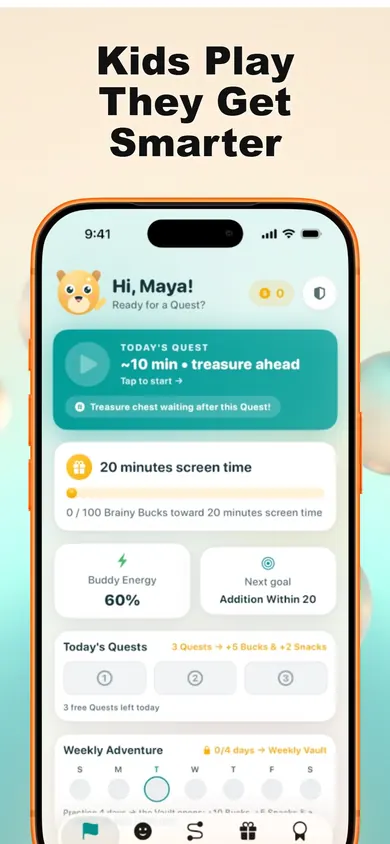
The routine above needs a book and you. Brainy Bucks covers the practice in between. Its daily quest mixes reading questions on main idea, sequencing, inference, context clues and vocabulary, with short original passages, plus phonics and math. Difficulty adapts to the answers your child actually gives, and any question can be read aloud on-device.
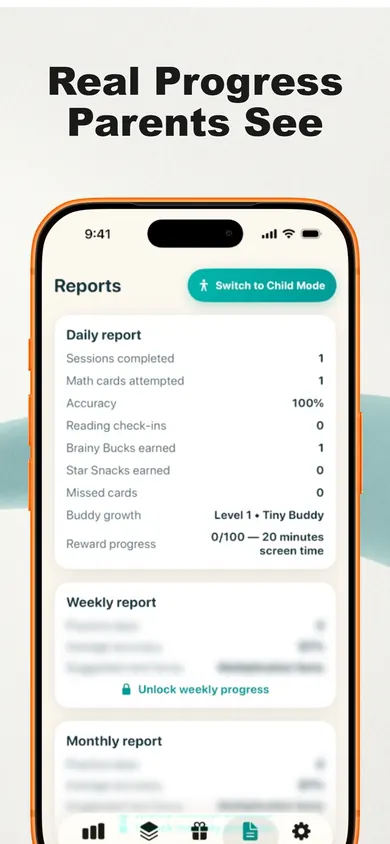
Parents get a one-sentence weekly summary and up to three short learning suggestions built from your child's real answers. There are no ads, no accounts and no chat, and Child Mode shows no prices or purchase buttons.
Parent questions
How long should a third grader read at home each night?
There's no single official number. Many families aim for 10 to 20 minutes. A short, regular session with one good question after it is easier to keep up than a long one.
My child reads fluently but can't say what happened. Why?
Reading the words and understanding them are different skills. Try the retell and fix-up questions in the picker, and ask them to stop after each page to say what just happened.
Is the demo passage from a real book?
No. We wrote it for this page so the inference question has one clear answer and a clue to point back to.
Is Brainy Bucks free?
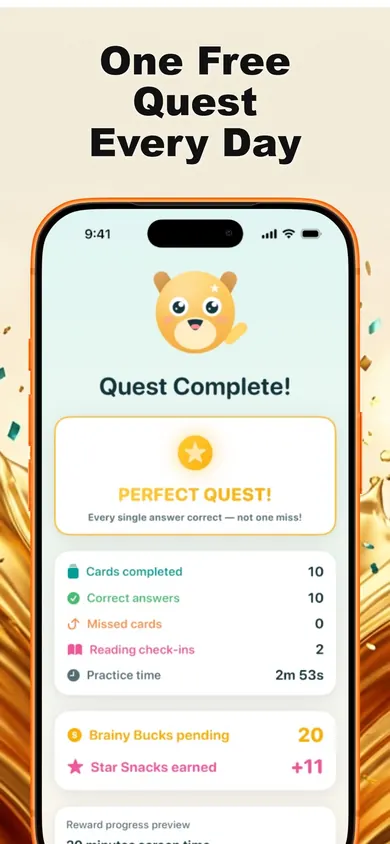
Yes. One adaptive quest is free every day, plus 3 extra quests a day, hints, second tries, spaced review and the weekly summary. Brainy Bucks Plus is an optional subscription or one-time Lifetime purchase for unlimited quests and the full library.
Honest limits
We kept the picker to one question a night on purpose, because a long quiz after a story is the fastest way to make reading feel like homework. The limits are real too. This page is a parent's adaptation of a teachers' guide, not a reading program. Brainy Bucks' skill statuses are based only on answers given in the app, and its listing says they are not a formal assessment. Its deepest coverage runs from Kindergarten to Grade 4.
Who should pick something else: if you're worried about decoding, a possible reading difficulty, or your child is far behind classmates, start with their teacher or school, who can assess properly. An app or a question picker won't diagnose anything.
One question tonight. One quest tomorrow.
Read-aloud, hints, second tries and a weekly summary for parents, with one adaptive quest free every day.